
How to Use Deriv MPESA Deposits in Kenya
Learn how to make seamless Deriv MPESA deposits in Kenya 💸, avoid common pitfalls, understand fees, and keep your transactions secure with our easy guide 🔒.
Edited By
Sophie Mitchell
When you want to withdraw KS0,000 from M-Pesa, the cost isn’t fixed — it depends on where and how you cash out. Understanding these fees matters, especially for those who move money daily or in large sums, like traders, investors, and finance pros.
M-Pesa charges a fee based on the withdrawal amount but also varies by withdrawal channel. For example, withdrawing from an M-Pesa agent usually incurs a different fee than using an ATM linked to your M-Pesa account. It helps to know these differences before you pull out cash.
Here’s a quick look at typical charges for withdrawing KS0,000 as of 2024:
M-Pesa Agent Withdrawal: Usually costs around KS5 for amounts between KS,000 and KS0,000.
ATM Withdrawal (KCB or Cooperative Bank with M-Pesa card): Fees range from KS0 to KS00 depending on the bank and ATM owner.
These fees might seem small individually, but they add up when you withdraw regularly. Choosing the right option can save you a noticeable amount over time.
In addition to these charges, withdrawing via agent or ATM also means considering access and convenience. An agent might be near your business, but an ATM could be faster if you need quick access outside banking hours.
To manage costs:
Plan your withdrawals – Withdrawing more than once a day adds fees each time.
Use M-Pesa agents where possible – They tend to charge less for small to medium amounts.
Avoid unnecessary cashouts – Use till numbers, paybills, or direct transfers when possible to limit withdrawal needs.
Knowing these fees lets you budget better and choose withdrawal methods that suit your activity, keeping more shillings in your pocket. Now, let’s look at each withdrawal method and the charges involved in more detail.
Knowing the charges involved when withdrawing money from M-Pesa helps you plan your transactions better and save unnecessary expenses. Since many Kenyans rely on M-Pesa for daily financial dealings, understanding these fees is practical both for personal budgeting and business operations. For instance, traders withdrawing KS0,000 to pay suppliers need to anticipate the exact cost so they can factor that into their cash flow.
M-Pesa withdrawal fees are the charges Safaricom applies when you take out cash from your M-Pesa account. These fees vary depending on the amount withdrawn and the withdrawal method. For example, withdrawing small amounts like KS00 attracts a lower fee, whereas larger amounts such as KS0,000 incur higher charges within specified brackets.
The fees serve as compensation for the services Safaricom provides and cover operational costs of agents, banks, and ATMs. This means the charges aren’t arbitrary—they reflect the expenses of running the network and ensuring secure, reliable cash access across the country.
Primarily, withdrawal fees are necessary to sustain M-Pesa’s broad infrastructure, including the vast network of agents in both urban and rural areas. These agents handle cash on behalf of Safaricom, and fees partly cover commissions paid to them. Without these fees, agents would struggle to maintain their operations, reducing convenient access for users.
Secondly, fees help Safaricom manage risks related to handling physical cash and digital security. Processing cash withdrawals involves handling large volumes of currency, cash float management, and guarding against fraud, all of which require funding sourced from transaction fees.
When you withdraw from M-Pesa agents — kiosks or shops registered to handle M-Pesa transactions — you pay a fee based on the withdrawal amount. These fees compensate agents for their cash handling and operational efforts. The convenience of local agents makes this method the most common, especially in areas where banks or ATMs are scarce.
Transferring funds from M-Pesa into a linked bank account may attract withdrawal fees, although charges tend to be different from agent fees. Banks usually charge a set fee or a percentage of the amount transferred, depending on their policies. Time taken for the transfer also varies, which might impact when the cash becomes available.
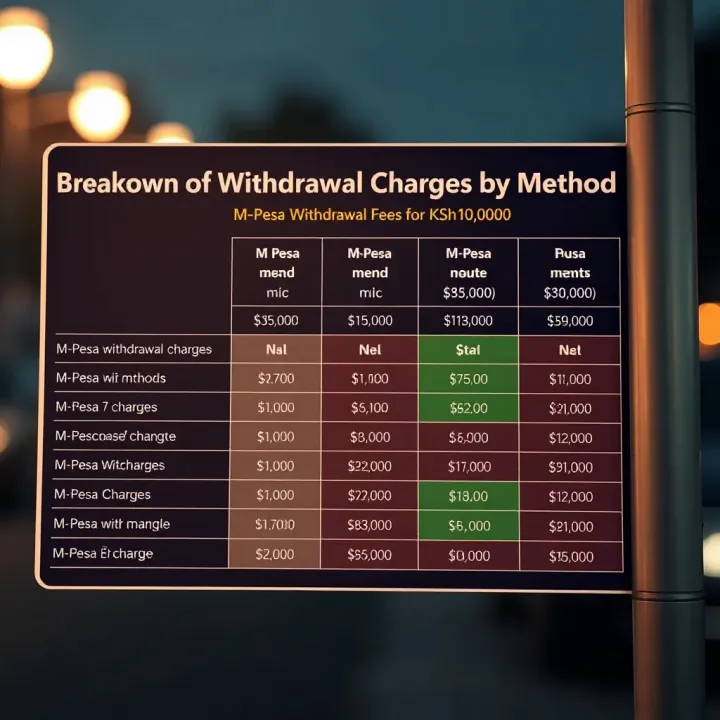
Withdrawing M-Pesa funds via ATMs involves fees charged by both Safaricom and the bank operating the ATM. Typically, these charges add up, making ATM withdrawals pricier compared to agent withdrawals. However, ATMs provide quick, 24/7 access to cash in urban areas, offering convenience that may justify the costs for some users.
M-Pesa withdrawal fees vary by method and amount but are always designed to cover operational costs and ensure the system runs smoothly while providing helpful cash access across Kenya.
When withdrawing KS0,000 from M-Pesa agents, understanding the fees involved is key for anyone looking to manage expenses effectively. Since many Kenyans rely on agent outlets for daily cash-outs, knowing typical charges helps traders, investors, and finance professionals plan their cash flows accurately. This section covers the usual fees and provides practical insights on how these costs are calculated.
M-Pesa withdrawal fees are set within specific brackets depending on the amount being withdrawn. For example, smaller withdrawals like KS00 to KS000 have relatively low fees, while larger amounts attract higher charges. Importantly, charges for amounts between KS,001 and KS0,000 fall within a defined bracket where a fixed fee applies. This tiered structure ensures the fees correspond broadly with the withdrawal size, which motivates users to be strategic about how much they withdraw at a time.
The fee for M-Pesa agent withdrawals is a fixed amount depending on the withdrawal bracket – it does not fluctuate based on percentages. For instance, withdrawing between KS,001 and KS0,000 typically attracts a flat fee of KS10. This simple fee calculation makes it easier for consumers to anticipate exact costs when planning withdrawals rather than guessing a percentage-based deduction. This straightforward approach helps reduce surprises, especially for traders managing tight margins.
For a withdrawal of exactly KS0,000 at an M-Pesa agent, you can expect to pay a standard fee of KS10. This means if you want to walk away with KS0,000 in cash, you should have KS0,110 available in your M-Pesa account. Knowing this fixed fee upfront lets you budget effectively, whether you’re withdrawing for business expenses, investments, or personal use.
To put the charges in perspective, withdrawing less than KS,000 comes with a much smaller fee – for example, withdrawing KS00 might cost you only KS5. On the other hand, amounts above KS0,000 enter the next fee bracket, which is higher; withdrawing between KS0,001 and KS0,000 could cost KS60 or more. This shows the cost efficiency of sticking close to the KS0,000 bracket if practical, to minimise fees. Understanding these different tiers helps businesses and individuals decide when to withdraw funds or use direct payment alternatives to save on costs.
Always confirm charges at the specific agent as some might add small convenience fees, but M-Pesa’s official withdrawal fees are capped and should be followed consistently.
This fee structure reflects typical costs at most M-Pesa agents across Kenya, providing a reliable baseline for budgeting withdrawals. Being aware of how fixed fee brackets work allows you to make strategic decisions on cash management without unnecessary extra costs.
When retrieving KS0,000 from M-Pesa, bank transfers and ATM withdrawals offer useful alternatives to agent cash-outs. Understanding how these options work can save you both time and money, especially if you’re managing larger transactions frequently. Traders and finance professionals often juggle multiple withdrawals, so knowing these methods well can streamline cash flow.
Bank transfers let you move money from your M-Pesa wallet directly into your bank account. This is handy if you don’t need immediate cash but want to access funds through your bank’s channels, like cheques or inter-account transfers. To start, you usually access M-Pesa’s “Lipa na M-Pesa” or “Bank Services” menu, select the bank, enter your account number, and confirm the amount.
Charges for bank transfers vary depending on the bank and amount transferred. For withdrawing KS0,000, most banks charge a nominal fee, often between KS0 to KSh60, slightly higher than agent withdrawal charges. This fee covers M-Pesa’s service and the bank’s processing costs.
The transaction time for a bank transfer from M-Pesa to your account typically takes a few seconds to a few minutes during banking hours. However, some banks may take up to 24 hours, especially if the transfer occurs after banking hours or on weekends. Fast transfers mean you can access your funds without waiting for agents or queuing at ATMs.
Withdrawing directly from an ATM using your M-Pesa wallet is getting more popular in urban centres. The process usually involves generating a withdrawal code from the M-Pesa app or USSD menu. You enter this code on the ATM interface, input the withdrawal amount, and collect your cash, all without a bank card.
The fees here include a charge from M-Pesa’s side, similar to agent withdrawal fees, plus any ATM service fee imposed by the bank operating the ATM. For a KS0,000 withdrawal, expect to pay around KS10–KS20 in total, though this varies by bank and ATM location.
The benefits of ATM withdrawals are convenience and wider availability outside agent hours, as many ATMs operate 24/7. Yet, drawbacks include higher fees compared to agents and the need to find an M-Pesa-compatible ATM. Additionally, not all ATMs support M-Pesa withdrawals, limiting accessibility, especially outside Nairobi and major towns.
For those handling large cash flows, bank transfers offer good value with minimal fees but slower access, whereas ATM withdrawals give immediate cash but at higher costs.
In summary, the right option depends on your priorities: cost-saving for frequent large transfers favours the bank route, while quick cash needs may push you towards ATM withdrawals despite the extra fees. Knowing this helps you manage your KS0,000 withdrawals efficiently, cutting unnecessary costs wherever possible.
Withdrawing money from M-Pesa comes with unavoidable fees, but knowing how to reduce these costs can save you a significant amount over time. Especially for traders, investors, and finance professionals who handle cash flow regularly, optimising these fees means more money stays in your pocket rather than paying unnecessary charges. Let’s look at practical ways to keep withdrawal costs low.
When deciding where to withdraw your KS0,000 from M-Pesa, it makes sense to compare the different points available. M-Pesa agents usually charge a set fee for amounts like KS0,000, often slightly higher than fees for bank transfers or ATM withdrawals, although bank-related fees depend on the linked bank’s policy. ATMs tend to have mixed costs — with M-Pesa charging a withdrawal fee plus the ATM provider’s fee, meaning costs could add up.
Picking the right option depends on your priorities. If immediate cash is essential and convenience matters, using agents might be best despite slightly elevated charges. Conversely, a bank transfer might take longer but could save you some money if the bank does not impose additional fees. ATM withdrawals can be handy, especially in urban areas, but remember that double fees apply. Ideally, keep track of all fees charged to identify which method suits your withdrawal habits and frequency.
Another smart way to reduce withdrawal costs is cutting down on cash-outs by using M-Pesa’s payment options directly. You can pay suppliers, settle bills, or transfer money to others right from your mobile phone. For example, many traders in Nairobi prefer to pay rent or stock suppliers through M-Pesa transfers instead of withdrawing outright cash, which helps them avoid withdrawal fees completely.
Saving costs by skipping withdrawals has practical benefits beyond fees. It reduces risks related to carrying cash and saves time otherwise spent queuing at agents or ATMs. When you pay directly, the transaction is instant and secure, contributing to smoother business and personal money management. For those who’re regularly handling transactions worth KS0,000 or more, this approach can cumulatively save a lot over months.
Minimising withdrawal costs isn’t only about saving a few shillings; it improves how you manage your money and business operations. Choose wisely between agents, banks, and ATMs, or better yet, use direct payments through M-Pesa to keep your expenses lean and efficient.
Understanding the common questions around M-Pesa withdrawal fees is key for traders, investors, analysts, brokers, and finance professionals who manage cash flows regularly. Withdrawal charges aren't just about cost; they influence liquidity management, budgeting, and operational efficiency. Addressing these questions helps clarify how fees operate and how to approach withdrawals strategically.
Withdrawal fees on M-Pesa are generally variable rather than fixed. The charges depend on the amount withdrawn, and M-Pesa applies a tiered fee structure. For example, withdrawing KS0,000 attracts a specific fee that’s different from withdrawing KS,000 or KS0,000. This approach means as withdrawal amounts increase, fees also rise but not necessarily in a straight line.
The fees are also different based on the withdrawal method—for instance, using an M-Pesa agent might incur lower fees compared to ATMs or bank transfers. Knowing this variable fee structure helps traders estimate exact costs when moving money between mobile wallets and cash.
M-Pesa fees can change, but the regulations require Safaricom to notify customers before implementing any adjustments. While some fee changes might feel sudden, in most practical cases, you will find announcements via Safaricom’s official channels or SMS alerts. Businesses and finance professionals should keep an eye on these updates, as fee changes can affect margins, especially for those dealing with large or frequent withdrawals.
It’s worth noting that occasional promotional periods or adjustments might temporarily reduce or increase fees, so staying updated allows you to plan withdrawals more cost-effectively.
Yes, the withdrawal location significantly affects fees. Withdrawing KS0,000 from an M-Pesa agent in a rural area could have a slightly different fee compared to an urban centre, due to operational costs and agent commissions. Furthermore, fees can vary when withdrawing from M-Pesa at bank ATMs or through bank account transfers.
For traders or investors who operate across counties, being aware of these regional fee variations is important. For example, withdrawing cash in Kisumu might attract a standard fee of KShXX, while Nairobi agents could charge differently due to higher foot traffic and operational overheads.
Understanding these location-based differences helps in planning withdrawal points that yield better cost efficiency without compromising convenience.
Being clear on these common questions empowers finance professionals to manage M-Pesa withdrawals smartly, saving money and time while improving cashflow predictability.
Learn how to make seamless Deriv MPESA deposits in Kenya 💸, avoid common pitfalls, understand fees, and keep your transactions secure with our easy guide 🔒.
📱 Discover how D Mpesa simplifies secure transactions in Kenya, offering key features, usage tips, and its role boosting the local economy.
🎁 Discover how to claim and instantly withdraw your $25 sign-up bonus! Learn eligibility, terms, and tips designed for Kenya's online gaming and promo fans.

🔍 Learn how to link Deriv with MetaTrader 5 for smooth trading 🚀 Get setup tips, explore features, try strategies, and manage risk effectively!
Based on 9 reviews