
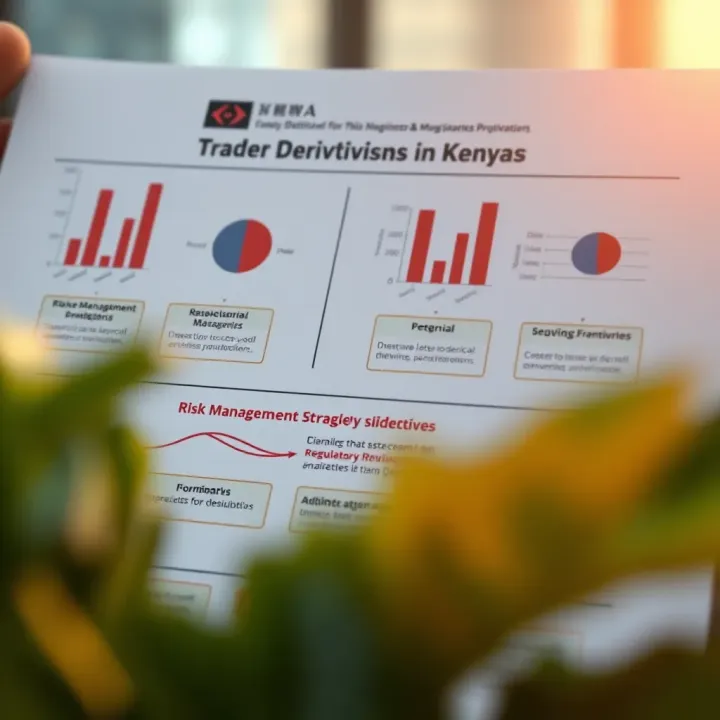
Trader Derivatives: A Guide for Kenyan Investors
📈 Learn how trader derivatives work in Kenya’s market, explore types, risks, strategies, and local regulations to trade confidently and protect your KSh investments.
Edited By
Henry Davies
The volatility index, often known as the VIX, offers a snapshot of how much investors expect the stock market to swing over the coming weeks. It is essentially a gauge of market uncertainty or nervousness. For Kenyan investors, understanding the VIX can be a handy tool to gauge risk and prepare for potential market ups and downs.
Unlike traditional indicators that track prices or earnings, the VIX measures expected price fluctuations based on options prices—contracts giving the right to buy or sell shares at specific prices. As these options reflect investor sentiment, a rising VIX often signals growing fear or doubt among traders, while a falling VIX indicates calm or confidence.

The volatility index acts like a market thermometer, showing if investors are feeling hot-headed or cool-headed about the future.
In practice, this matters to Kenyan investors because market jitters in Nairobi Securities Exchange (NSE) can cause rapid price changes in shares or bonds, which in turn affect investment returns. For example, during global shocks like the 2008 financial crisis or the COVID-19 pandemic, volatility spikes dramatically, shaking the NSE just like other markets.
Here are key points to understand about the volatility index:
What it measures: Expected volatility of the market over the next 30 calendar days, often expressed as an annualised percentage.
Calculation: Derived from prices of options on major market indices, such as NSE 20 Share Index options, though Kenya lacks a direct equivalent to US VIX.
Investor sentiment: A high volatility index suggests caution and risk aversion; a low one shows optimism.
Market risk indicator: Helps investors anticipate market turbulence and adjust portfolios accordingly.
Kenyan investors can use the volatility index as part of risk management strategies. For instance, if the volatility index starts climbing, it could be a signal to reduce exposure in riskier shares or prepare for potential losses. Meanwhile, stabilising or low volatility might encourage increased investment or diversification.
Though Kenya does not yet have a formal VIX product, traders and analysts relying on NSE indices and international benchmarks can still monitor global volatility trends to gauge likely spillovers locally. This understanding aids in making more informed, less reactive decisions amid market fluctuations.
Overall, getting comfortable with volatility as a concept equips Kenyan investors with a sharper lens to read market moods, helping them protect their investments and seize opportunities.
Understanding the Volatility Index is essential for investors who want to get a clear picture of market mood and uncertainty. This index acts like a weather forecast for financial markets, offering clues on how much prices might swing in the near future. For Kenyan investors, knowing this helps in planning, especially during times when global or local events shake market confidence.
The Volatility Index, often shortened to the "vol index," measures the market's expected volatility over a specific period, typically 30 days. It uses prices of options—financial contracts giving the right to buy or sell assets—to gauge how much movement the market expects. Think of it as a thermometer for fear and uncertainty among traders; higher values mean a shakier market is anticipated.
This index calculates implied volatility, which is the market's forecast of future price movements based on option prices. If traders expect big swings in stock prices, option premiums rise, pushing the volatility index up. Conversely, a calm market with little expected movement keeps the index low. For example, if political unrest arises in a trading partner country or unexpected economic data drops, investors will watch the volatility index climb, signalling higher risk.
The Chicago Board Options Exchange’s (CBOE) Volatility Index, known as the VIX, is the most widely referenced globally. It tracks expected volatility of the S&P 500, a major US stock market gauge. Although it relates to US markets, many Kenyan investors follow the VIX because global market swings often ripple into the Nairobi Securities Exchange (NSE). For instance, during major US economic announcements, VIX movements hint at how Kenyan equities might behave.
Apart from the VIX, other regions have their own volatility measures reflecting local market dynamics—such as the Euro Stoxx 50 VSTOXX in Europe or the Nikkei Volatility Index in Japan. While Kenya doesn’t yet have a dedicated volatility index, investors can track these regional counterparts along with the VIX to gauge global investor sentiment, which often impacts NSE trading. Understanding these helps local investors align their strategies with wider market conditions.
Being aware of how volatility indexes work provides Kenyan investors with an extra tool to assess risks and potential opportunities, guiding smarter decisions in an unpredictable market.

Understanding how the Volatility Index is calculated helps investors grasp the source and reliability of the index as a market tool. This knowledge is vital to interpret the index accurately and use it effectively in Kenyan markets, especially when deciding on risk strategies or timing trades.
The Volatility Index mainly depends on prices of options, which are contracts giving the buyer the right—but not the obligation—to buy or sell an asset at a certain price before a set date. These options reflect traders’ expectations about future market movements. When options prices rise sharply, it usually signals increased uncertainty or fear in the market, pushing the volatility index higher.
For example, the well-known VIX index in the US uses prices of S&P 500 index options to calculate expected market turbulence over the next 30 days. Similarly, even though Kenyan markets don’t have a widely established volatility index, understanding how option prices indicate risk helps local investors gauge sentiments. Increased premiums on options related to NSE stocks, such as Safaricom or KCB Group, could suggest investors expect more price swings soon.
Implied volatility is a key concept behind the volatility index. It represents the market's forecast of the likelihood that prices will fluctuate sharply in the future. Unlike historical volatility, which looks at past price changes, implied volatility looks forward, extracting expectations from current option prices.
Think of implied volatility as the market’s ‘mood meter.’ When investors worry about political developments before an election or about changes in central bank interest rates, implied volatility tends to climb. In Kenya, implied volatility would spike around events like new tax policies announced by KRA or during global shocks that affect NSE stocks indirectly.
The numerical value of a volatility index is expressed as a percentage and shows the expected annualised price movement of the underlying market over the coming 30 days. For instance, a volatility index reading of 20 means the market expects a 20% change, up or down, if annualised.
That said, short-term spikes or dips don’t always mean markets will crash or boom. Kenyan investors should treat the number as a sentiment barometer rather than a concrete forecast. If the volatility index surges suddenly, it signals heightened uncertainty—so, it may be time to review your portfolio to safeguard against possible shocks.
Remember, the volatility index is less about predicting exact price changes and more about showing ahead of time how much price swings investors think the market will experience.
By understanding the calculation fundamentals, Kenyan investors gain clearer insight into market risk moods and can make better-informed decisions tailored to their local context.
The Volatility Index provides a snapshot of how jittery or calm the market feels at any given time. For investors, it’s a quick way to gauge market mood without digging through heaps of financial reports. When volatility spikes, it usually points to rising concern or uncertainty — something every investor should notice before making decisions.
Think of the Volatility Index as the market’s emotional barometer. When the index climbs, it suggests investors are nervous about potential price swings ahead. For example, during the 2020 COVID-19 outbreak, global volatility indexes surged, reflecting fears of an economic slowdown. Kenyan investors following such trends can better anticipate potential shocks to NSE stocks or forex markets.
A rising volatility index often signals fear or uncertainty, while a falling index generally shows calm and confidence among investors.
The index helps investors weigh how risky the market environment is. If volatility is high, it often means bigger price swings, making investments more unpredictable. Local investors might see this as a cue to protect their portfolios with safer assets like government bonds or diversify into less volatile sectors. For example, a fund manager in Nairobi might reduce exposure to high-growth but unstable shares during high volatility periods.
Volatility and market direction usually share a close relationship. Sharp price falls tend to push the Volatility Index higher as fear spikes. Conversely, when markets steadily rise, volatility often fades. However, the link is not always straightforward; sudden events can cause short bursts of volatility without a big market shift. In Kenya, understanding this relationship can help investors avoid panic selling during temporary shocks, such as currency shakiness due to global shocks or political uncertainties.
By keeping an eye on the Volatility Index alongside local economic news and NSE trends, Kenyan investors can make more informed moves. This awareness helps manage risk better and can lead to smarter timing for buying or selling assets. Ultimately, the index offers valuable insight that goes beyond price charts alone, shaping how investors safeguard and grow their wealth.
Understanding volatility is key for Kenyan investors looking to make decisions in a market influenced by both local and global factors. Applying insights from the Volatility Index helps investors gauge market uncertainty, manage risk better, and time their trades effectively amidst the Nairobi Securities Exchange (NSE) dynamics.
Global market swings often ripple through Kenya's financial markets due to interconnected economies. For instance, unrest in major markets like the US or China causes investor jitters worldwide, which in turn impact NSE stock prices and volumes. When the global Volatility Index spikes, indicating turbulent times, NSE experiences increased price swings, especially in blue-chip firms such as Safaricom or Equity Bank. Investors who track these global signals avoid being caught off guard by sudden Nairobi market fluctuations.
Locally, volatility can be triggered by political events like election cycles or policy changes affecting sectors such as agriculture or banking. Investors using volatility data can adjust their portfolios – reducing exposure to high-risk stocks or shifting towards stable government bonds and money market instruments when swings intensify. Take the 2022 general elections; jitters led to an uptick in NSE volatility, prompting savvy investors to rebalance towards less risky assets. By reading volatility signals correctly, investors can protect their capital and seize opportunities when markets calm down.
Kenyan traders benefit from applying volatility insights to decisions on holding periods and asset selection. When the index shows rising uncertainty, short-term traders might reduce their positions or hedge using derivatives where possible. Meanwhile, long-term investors may wait for volatility to subside before entering new positions or use dips caused by spikes to buy quality stocks at lower prices. On top of that, sectors such as manufacturing or tourism, sensitive to economic cycles, often reflect volatility shifts distinctly, empowering investors to reposition their funds accordingly.
Volatility indexes offer a real-time snapshot of market mood. Kenyan investors who integrate these insights can better navigate unpredictability, minimise losses, and capture growth phases efficiently.
In summary, applying Volatility Index insights equips Kenyan investors with an early warning system and a better toolkit for managing their investments amid shifting local and global market conditions.
Kenyan investors can gain a real advantage by making smart use of the volatility index as part of their investment toolkit. This index offers insights into market mood swings and possible risks, allowing investors to act more deliberately rather than reactively. Let’s explore how you can put this tool to work through risk management, timing, and portfolio balancing.
Volatility spikes often mean heightened uncertainty, which increases chances of losing money, especially in equities. To protect your investments, hedging comes in handy. For instance, if you hold stocks listed on the Nairobi Securities Exchange (NSE) and notice the volatility index climbing, you might consider buying protective put options or investing in safer assets like government bonds temporarily. This way, even if the market turns shaky, your losses can be limited.
Hedging also includes diversifying into assets less affected by local market shocks — say, dollar-denominated bonds or investments in sectors like telecommunications and utilities, which tend to be steadier during turbulent times. The key is watching volatility signals as an early warning and acting before things worsen.
Volatility can help you decide the best moments to enter or exit a market. When the volatility index is low, it usually reflects calm markets, which might be a good time to buy quality stocks at reasonable prices. Conversely, when volatility spikes, fear tends to push prices down, sometimes below their true value. This can become an opportunity for disciplined investors to buy quality investments at a discount.
On the other hand, a sudden rise in volatility might also signal a good time to take profits or reduce exposure to risky assets. However, relying solely on the volatility index for timing may be risky; it works best combined with other tools like fundamental analysis of companies listed on NSE or monitoring economic indicators such as inflation and interest rates set by Central Bank of Kenya.
A well-balanced portfolio is key to managing risk, and the volatility index can guide you in adjusting asset allocation. For example, if the index suggests rising turbulence ahead, you might reduce exposure to high-volatility sectors such as banking and increase holdings in defensive assets like consumer goods or real estate investment trusts (REITs) that provide regular income.
Regularly reviewing your portfolio against volatility changes helps maintain a risk profile you're comfortable with. Kenyan investors can also consider exposure to foreign markets or commodities to spread risk further, especially in times when local markets show signs of instability.
Applying the volatility index thoughtfully lets you mitigate losses, spot buying or selling chances, and keep your investment portfolio resilient to shocks.
In summary, using the volatility index is not about predicting every market movement but about managing your approach with better information. Kenyan investors who incorporate hedging, timing, and portfolio balancing based on volatility readings are better placed to handle market ups and downs wisely.
📈 Learn how trader derivatives work in Kenya’s market, explore types, risks, strategies, and local regulations to trade confidently and protect your KSh investments.
📊 Discover how to choose the right trading platform for Kenyan investors. Learn about features, security, fees, and mobile access suited to Kenya's market.

📊 Learn forex trading basics, market tips, and risk strategies tailored for Kenyan investors. Start smart, avoid common pitfalls, and grow your KSh portfolio today!
📈 Explore commodity trading in Kenya with practical tips on key markets, trading platforms, local trends, risks, and how to seize opportunities for better returns.
Based on 5 reviews